English
  عربى
عربى  中文简体
中文简体 Hand-Stitched Style Poly-Cotton Fabric for Sarong— a refined blend of style and practicality, crafted to give tube skirts a smooth texture and a well-...
See DetailsCultural Storytelling Through Woven Patterns: Motifs, Meaning and Mill Craft
Industry News-Content
- 1 Why Pattern Carries a Story That Print Cannot
- 2 A Pattern-to-Story Map We Use in House
- 3 Reading a Sarong: Story in Everyday Wear
- 4 The Keffiyeh: A Pattern Read Across the Arab World
- 5 Dai Weaving and the Motifs That Cross Borders
- 6 Turning a Story Into a Loom-Ready Brief
- 7 Telling Someone Else's Story Respectfully
- 8 Working With a Mill That Reads the Motif
- 9 Cloth as a Record
Ask anyone who has worn a sarong to a wedding or tied a keffiyeh before Friday prayers, and they will say the same thing: the cloth is never only cloth. Stripes, checks, florals and gold borders work as a vocabulary. Cultural storytelling through woven patterns is how families, villages and whole regions keep memory alive, not on paper but in weave repeats, dye choices and the way a border sits against its ground.
We have been weaving in Linghu, Huzhou since 2006, mainly for Southeast Asian and Middle Eastern markets. The strongest developments we see rarely begin with a colour number. They begin with a story a garment is meant to tell. This guide covers how woven motifs carry meaning, how that meaning survives the loom, and how to brief a mill so the story arrives intact at the cutting table.
Why Pattern Carries a Story That Print Cannot
A printed motif sits on top of cloth. A woven motif is the cloth. When a pattern is doing cultural work, that difference changes what the fabric can do in daily use.
- Permanence. Interlaced colour survives washing and decades of folding. A grandmother's sarong still shows its border because the border is structure, not surface.
- Rhythm. A repeat is a loop of decisions: how many picks of gold, how wide the ground, where the lattice opens. Rhythm is what makes a motif readable at ten metres.
- Touch. Jacquard floats and dobby textures give the hand a reading path. A hand-stitched look signals care; an openwork weave signals airflow.
- Continuity. Motifs travel. A check born as desert headwear can reappear on a tube-skirt border thousands of kilometres away and still read as familiar.
That is why cultural patterns remain such a durable design engine. They arrive with meaning already attached, so the garment starts the conversation halfway through.
A Pattern-to-Story Map We Use in House
Buyers often send a reference photo and ask what it should become in production. The table below is the shorthand we work from: motif family, the story it usually carries, the weaving route we would recommend, and where that cloth tends to end up.
| Motif family | Story it carries | Weaving route | Typical end use |
|---|---|---|---|
| Houndstooth and fine checks | Discipline, order, inherited identity | Jacquard or dobby, cotton or polyester | Keffiyeh, head scarves, suiting |
| Gold-thread plaid border | Status and celebration, the frame of an occasion | Jacquard with metallic weft at the edge | Keffiyeh, ceremonial sarong |
| Openwork geometric lattice | Lightness, blessing, air moving through | Hollow polyester jacquard | Lao and Thai traditional sarong |
| Flowing floral repeats | Seasons, fertility, abundance | Printed or jacquard on polycotton | Sarong, tube skirt, dress fabric |
| Vertical stripe with gold thread | Lineage and vertical order | Colour weaving plus metallic yarn | Pha Sin, formal sarong |
| S-shaped three-dimensional texture | Tradition re-read by a new generation | Textured polyester jacquard | Fashion sarong, resort wear |
| Two-tone cotton plaid | Everyday identity, market-day cloth | Cotton plain or dobby weave | Daily sarong, shawl |
Reading a Sarong: Story in Everyday Wear
Nowhere is woven narrative more legible than in the sarong. The Thai Pha Sin, the Lao tube skirt and the Dai skirt of southern Yunnan share the same grammar: a ground, a repeat, a border, and a hem that decides how the cloth falls when the wearer walks.
Choosing between jacquard, batik and ikat is not only a technical question. Ikat blurs because the yarn is dyed before weaving, batik resists, and jacquard builds the motif pick by pick. We compared all three techniques here, and the short version is that jacquard gives the crispest repeat and the most control when a motif must stay recognisable across thousands of metres.
Silk-like polyester jacquard is where many export programmes land: the lustre reads as celebratory, the weight drapes close to the heirloom original, and the price keeps the story accessible to a wider market.
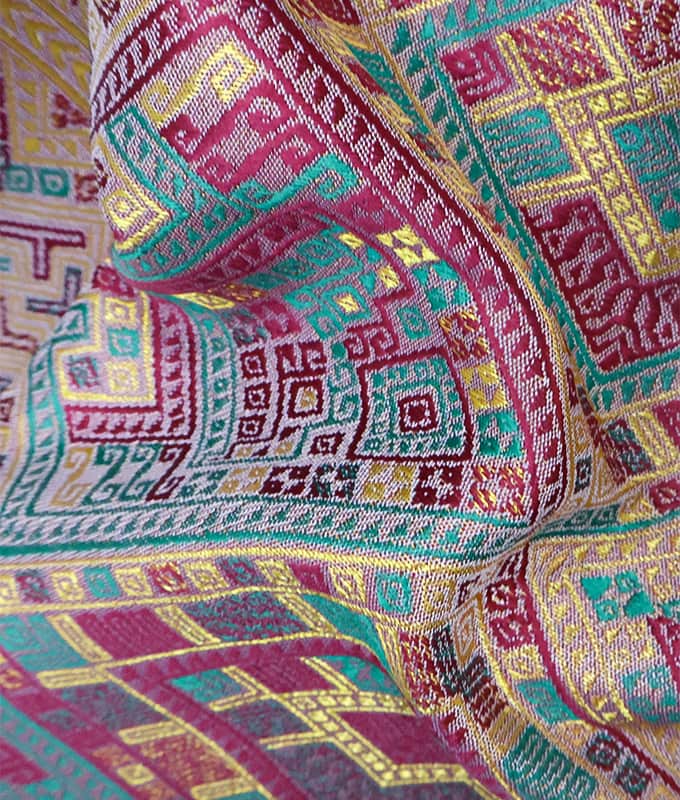 Silk-like Polyester Jacquard Fabric for Thai Pha Sinh SarongSilk-like Polyester Jacquard Fabric for Thai Pha Sinh Sarong — combining the elegance of silk-like texture with high-precision jacquard craftsmanship, designed to crea...View Product →
The Keffiyeh: A Pattern Read Across the Arab World
Head coverings carry some of the densest storytelling in textiles. The keffiyeh's fishnet ground, its contrast check and its woven border are read instantly by anyone who grew up with them, which means a supplier cannot treat colour as decoration. Get the border width or the check scale wrong and the cloth stops speaking.
Our cotton keffiyeh line includes a sage-green and navy houndstooth with a gold plaid border, a construction that keeps the traditional checks legible while offering a palette that photographs well on a modern shelf.
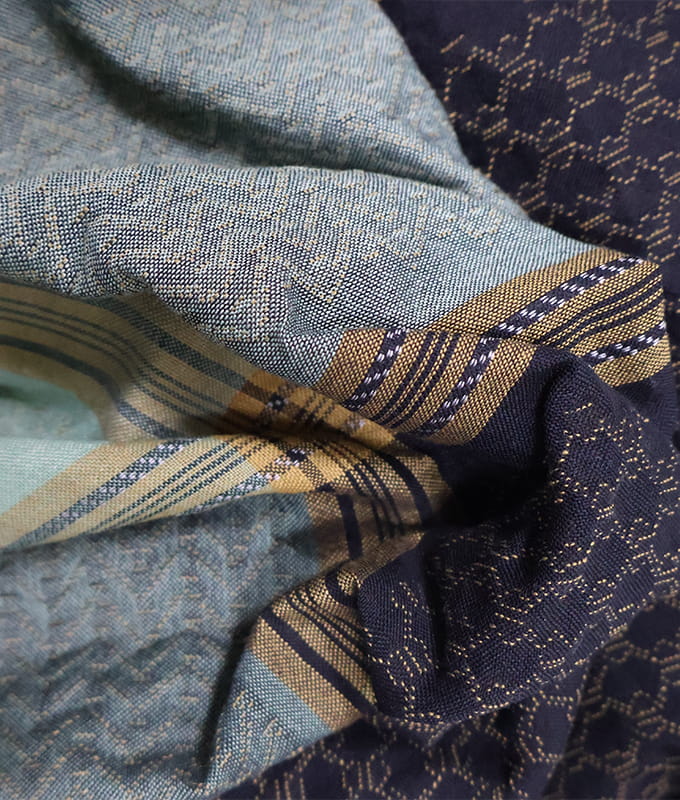 Sage Green & Navy Houndstooth Keffiyeh with Gold Plaid BorderThis oversized Arabic-style scarf combines two distinct woven patterns in a single panel, offering a contemporary twist on the traditional keffiyeh silhouette. One hal...View Product →
Dai Weaving and the Motifs That Cross Borders
Our own focus includes high-end Dai-style fabric for ethnic and special-occasion garments, and that work keeps reminding us how porous textile traditions are. Dai weavers have long used tight, lustrous constructions with fine geometric repeats, and closely related motif families appear in Lao and northern Thai cloth, arriving through trade routes rather than design meetings.
For buyers, the takeaway is practical. A motif is rarely owned by one village; it is shared, adapted and re-signed by each generation. When a brand wants a traditional look, the honest approach is to name the region and the garment rather than invent a single origin story.
Turning a Story Into a Loom-Ready Brief
A brief that respects the motif is usually a short one. These are the six points we ask for before sampling.
- Name the garment and the wearer, so weight and drape are decided before colour.
- Describe the motif in words first, then send the reference image.
- Set the repeat and the border width in centimetres, not in adjectives.
- Choose the fibre by use: cotton for breathability, polyester for lustre and durability, polycotton for balance.
- Decide the surface: matte, silk-like, openwork or hand-stitched effect.
- Ask for a hand sample, because a screen cannot show how a ground reflects light.
One construction worth knowing is the hand-stitched look: a woven imitation of hand-sewn panel joins that gives a tube skirt the irregular charm of a handmade piece with the consistency of a power loom.
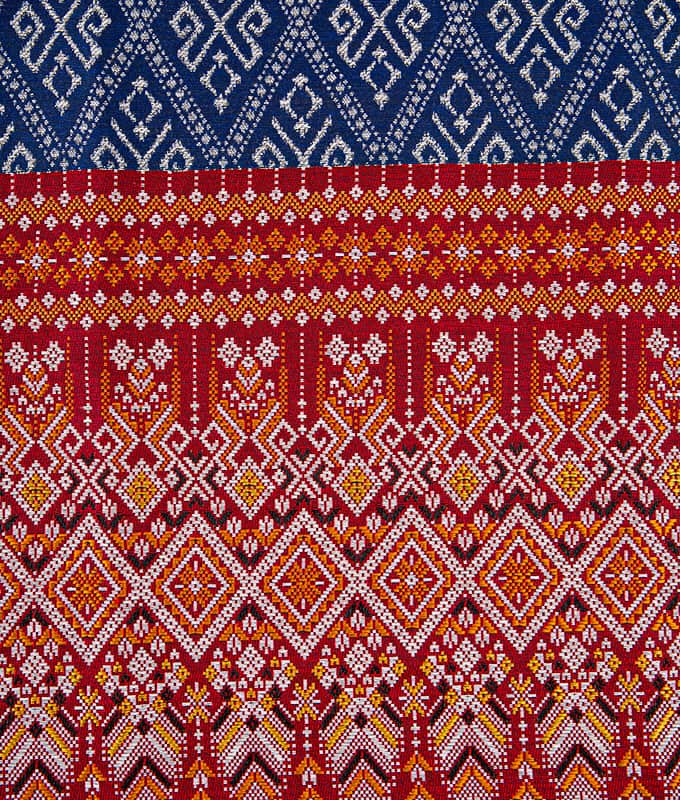 Hand-Stitched Style Poly-Cotton Sarong FabricHand-Stitched Style Poly-Cotton Fabric for Sarong— a refined blend of style and practicality, crafted to give tube skirts a smooth texture and a well-structured silhou...View Product →
Telling Someone Else's Story Respectfully
Working with heritage motifs carries responsibility, and most of it is simple good practice.
- Credit the region and the garment type in your product copy, not just the pattern name.
- Leave sacred or restricted symbols alone unless a cultural partner guides the design.
- Keep scale and proportion close to the original; shrinking a motif changes its meaning.
- Match fibre weight to the tradition, so the cloth behaves the way the wearer expects.
Doing this well is also commercially smart. Customers who know the cloth notice when a supplier has understood it.
Working With a Mill That Reads the Motif
Our mill sits in Linghu, Huzhou, roughly 100 kilometres from both Shanghai Pudong and Hangzhou Xiaoshan airports and 20 kilometres from the Shenjiahui expressway exit, which keeps sampling and export shipping straightforward. We run 80 staff, an in-house laboratory, small-batch production and custom development in cotton, polyester and polycotton, and our products meet European environmental standards.
If you are planning a programme for the coming season, start with the motif and the market, then let us handle repeat engineering, colour approval and sampling. You can browse our fabric range here, or send a reference with a target price and we will tell you honestly which construction will carry the story best.
Cloth as a Record
Patterns outlive the people who tie them. A check keeps travelling, a border keeps framing celebrations, and a repeat keeps a village's design vocabulary alive across oceans. Every order is a small act of transmission, which is exactly why cultural storytelling through woven patterns deserves a supplier who treats the motif as content rather than ornament.
Related products
-

-
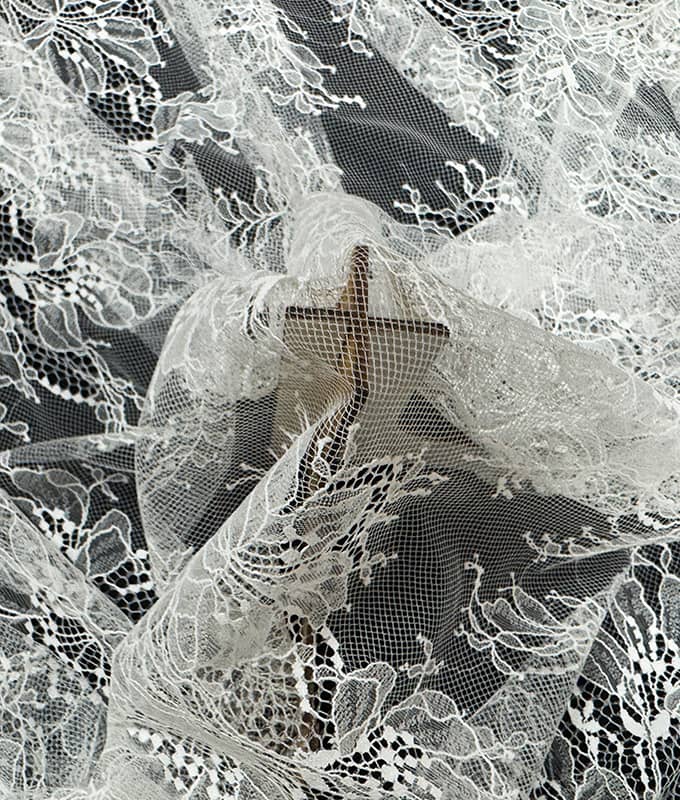
This warp-knit lace fabric features full-contoured large flower cluster motifs, with clearly defined petal layers and delicate stamen detailing. Flowi...
See Details