English
  عربى
عربى  中文简体
中文简体 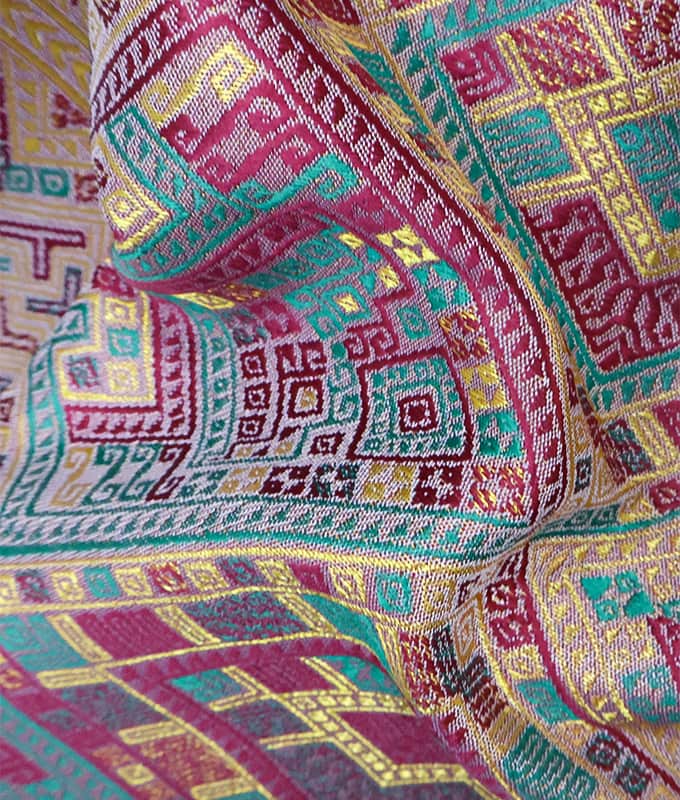
Silk-like Polyester Jacquard Fabric for Thai Pha Sinh Sarong — combining the elegance of silk-like texture with high-precision jacquard craftsmanship,...
See DetailsLongyi vs Pha Sin vs Kain: Key Differences Explained
Industry News-Content
- 1 Longyi, Pha Sin, and Kain differ mainly in region, construction, and how they are worn
- 2 Quick comparison of these sarong styles
- 3 What defines a longyi
- 4 What makes pha sin different
- 5 Why kain is the broadest and least specific term
- 6 The most useful differences are construction, function, and naming
- 7 Common mistakes when comparing longyi, pha sin, and kain
- 8 How to tell which term to use in writing, retail, or travel
- 9 Conclusion
Longyi, Pha Sin, and Kain differ mainly in region, construction, and how they are worn
Longyi is the everyday tubular wrap most strongly associated with Myanmar, pha sin is a traditional women's skirt from Thailand and Laos that is usually made in sections, and kain is a broader term used in parts of Maritime Southeast Asia for cloth that may be wrapped, sewn, draped, or tailored in different ways.
In practical terms, the easiest way to tell them apart is this: longyi is usually a ready-to-wear tube, pha sin is often a more structured ceremonial or regional skirt, and kain refers to cloth styles that vary widely by country, function, and draping method. Although all three belong to the wider family of sarong-like garments, they are not interchangeable labels.
That distinction matters because a buyer, traveler, writer, or researcher can easily misidentify one garment for another if they focus only on the fact that each wraps around the lower body. The deeper differences come from cut, weaving tradition, social use, and local terminology.
Quick comparison of these sarong styles
| Style | Primary region | Typical construction | How it is worn | Common context |
|---|---|---|---|---|
| Longyi | Myanmar | Usually a sewn tube | Wrapped at the waist and secured by folding or knotting | Daily wear, work, home, formal settings |
| Pha Sin | Thailand and Laos | Often a tubular skirt with distinct woven sections | Worn as a fitted lower garment, often with a blouse or shawl | Ceremony, dance, festivals, regional dress |
| Kain | Indonesia, Malaysia, Brunei, nearby regions | Can be an unsewn cloth or a sewn wrap | Wrapped, draped, pinned, or tailored depending on local style | Daily wear, ritual dress, formal attire, textile use beyond skirts |
This comparison shows why the word “sarong” can be useful as a broad category but inadequate as a precise label. Two garments may look similar from a distance yet differ in sewing method, cultural meaning, and the way the wearer secures the cloth.
What defines a longyi
A longyi is best understood as a cylindrical lower-body garment worn widely in Myanmar by both men and women, though styling differs by gender, fabric, and occasion. In many cases, the cloth is already sewn into a tube, which makes it practical for repeated daily use.
The everyday function of the longyi is one of its clearest identifiers. It is not limited to festivals or staged performance. People wear it at home, in markets, at religious sites, and in office or social settings depending on the fabric and pattern. That wide social range makes longyi closer to standard daily dress than occasional costume.
Structure and fastening
Most longyi garments are slipped on and secured at the waist with a fold, tuck, or front knot. This creates a cleaner and often more standardized silhouette than an unsewn rectangular wrap. For someone shopping or cataloging garments, the pre-sewn tube is often the first physical clue.
Patterns and material clues
Checks, stripes, floral prints, and solid tones all appear in longyi textiles. Cotton is common in everyday examples because it is breathable and easy to wash, while silk or shinier woven fabrics are more likely in dressier versions. In real use, fabric choice often signals class of occasion more clearly than the basic garment shape does.
What makes pha sin different
Pha sin is a traditional women's skirt associated especially with Thailand and Laos. Although it can also take a tubular form, it is often distinguished by its textile composition rather than by tube shape alone. Many pha sin garments are recognized by their clearly defined woven sections, often including a waistband area, main body, and decorated hem panel.
This sectional construction is important because it turns the garment into a textile statement. The lower border may carry detailed motifs, supplementary weaving, or local pattern language that helps identify region, ethnic group, or ceremonial use. That feature alone separates pha sin from simpler everyday wraps that do not emphasize structured panel design.
Regional and ceremonial identity
Pha sin often appears in festivals, temple visits, weddings, performances, and formal community gatherings. A plain daily version exists, but highly decorative examples are especially visible in public representations of regional dress. Because of that, many people first encounter pha sin through ceremony rather than streetwear.
How to identify it in practice
- Look for a skirt-like lower garment associated with women's dress.
- Check whether the textile is built from visually distinct horizontal sections.
- Notice whether the hem area is more decorative than the upper body of the cloth.
- Consider whether the garment appears in a formal, regional, or ceremonial setting.
Why kain is the broadest and least specific term
Kain is the most flexible term of the three. In several Southeast Asian languages, it can simply mean “cloth,” which means its scope is much wider than a single skirt style. Depending on the region, kain may refer to a wrap skirt, a ceremonial cloth, a batik textile, a songket textile, or a piece of fabric used in a larger outfit.
This is the biggest source of confusion: people often treat kain as if it were the exact equivalent of a single sarong form, but in practice it can refer to the textile itself, the garment made from it, or a local wrapping style.
Variation across regions
In one context, kain may be wrapped around the waist as a skirt. In another, it may be folded into pleats, pinned for formalwear, or paired with a tailored top in court or wedding dress. Because the term is so elastic, identification requires more than naming the cloth. Country, textile technique, and styling method all matter.
Textile type matters more than the base word
When the word kain appears with another descriptor, that second word often carries the real specificity. For example, the distinction may come from whether the fabric is resist-dyed, brocaded, woven with metallic thread, or intended for ceremonial dress. Without that qualifier, “kain” alone remains too broad for precise comparison with longyi or pha sin.
The most useful differences are construction, function, and naming
Construction
Longyi is commonly sewn into a tube. Pha sin may also be tubular, but it is often discussed in terms of its woven sections and ornamental structure. Kain may be unsewn or sewn, depending on local practice. If you need one quick physical test, construction is usually the fastest place to start.
Function
Longyi is strongly associated with everyday utility. Pha sin often carries stronger visual ties to formal, regional, or ceremonial presentation. Kain spans both practical and formal use, so context becomes essential. A museum label, travel guide, or product listing that ignores function may oversimplify the garment.
Naming
Longyi and pha sin are more specific garment terms. Kain is often a cloth term that becomes specific only with additional description. That is why “kain” needs more context than the other two words. In editorial or catalog use, broad terms should be narrowed with region or textile technique whenever possible.
Common mistakes when comparing longyi, pha sin, and kain
- Assuming all three are just different words for “sarong.”
- Ignoring whether the garment is sewn into a tube or left as a flat cloth.
- Treating kain as a single garment instead of a broad cloth term.
- Overlooking whether the garment is used for daily wear or ceremony.
- Focusing only on silhouette while ignoring regional textile patterns and named sections.
These mistakes are common because lower-body wraps across Southeast Asia can appear visually similar in photographs. Yet once you compare stitching, paneling, and cultural setting, the differences become much easier to see.
How to tell which term to use in writing, retail, or travel
Use “longyi” when the garment is specifically Burmese and tube-shaped
This is the right term when describing Myanmar's standard wrap skirt used in daily life, especially when the garment is sewn and worn by tucking or knotting at the waist.
Use “pha sin” when discussing traditional women's skirts from Thailand or Laos
This term works best when the garment has recognizable woven sections, decorated hems, or a clear connection to regional dress, ceremony, or performance traditions.
Use “kain” only with context
Because kain is broad, add location, textile type, or garment purpose. For example, describing it as a ceremonial wrap cloth, a batik kain, or a formal woven skirt is much clearer than using the word on its own.
Conclusion
The difference between longyi, pha sin, and kain is not just vocabulary. Longyi is the more specific everyday tubular wrap associated with Myanmar, pha sin is a traditional women's skirt from Thailand and Laos often recognized by its sectional woven design, and kain is a wider cloth term that needs local context before it becomes precise.
For accurate use, do not group them as identical sarong styles. Instead, identify where the garment comes from, whether it is sewn or unsewn, how it is worn, and whether the name refers to a garment form or simply to cloth. That approach produces clearer writing, more accurate product descriptions, and better cultural understanding.
Related products